
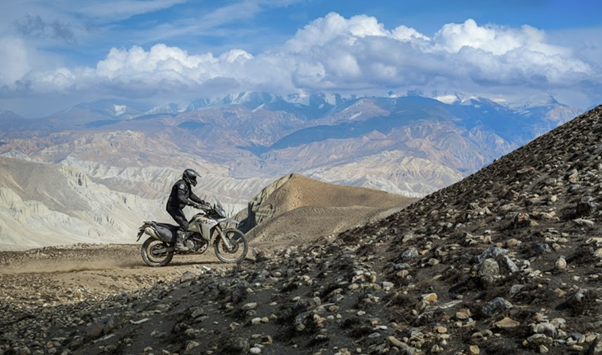
The Upper Mustang Bike Tour is among the wildest and most exclusive motorcycle tours in Nepal. It transports the riders into a distant desert region of the Himalayas, which is entirely unlike the green hills that most people will think of Nepal. This is a rain-shaded region of the Annapurna and Dhaulagiri ranges and hence a dry and rugged land, almost Tibetan in appearance.
The Upper Mustang Bike Tour is not only the ride on the motorcycle, but the knowledge of the difficult landscape, unpredictable weather conditions, high altitude, and the ability to control all these factors simultaneously and remain alive.
The Upper Mustang Bike Tour is a dream of many riders owing to the fact that it is pure adventure, with ancient monasteries, dramatic cliffs, deep gorges, and vast valleys. Nevertheless, it is not a smooth ride.
The challenge of the Upper Mustang Bike Tour rests on three broad parameters, namely terrain, weather and skill level of the rider. These are the important aspects that should be understood before setting up the trip.
This comprehensive article describes all the challenging particulars of the Upper Mustang Bike Tour in very straightforward terms, so that the riders will be able to plan the trip efficiently and experience it without any issues.
Overview of the Upper Mustang Region
The Upper Mustang is situated in north-central Nepal, bordering Tibet. The area begins approximately at Kagbeni village, which is located at approximately 2,810 meters (9,219 feet), as far as the old walled capital of Lo Manthang at approximately 3,840 meters (12,598 feet). The Upper Mustang Bike Tour could include some off-road excursions to heights over 4,000 meters (13,123 feet).
Due to its geographic position in the region outside of the main Himalayan range, Upper Mustang is very low in terms of rainfall relative to other regions of Nepal. This arid weather forms the land into dusty tracks, rocky routes, and sandy streams. The upper Mustang bike tour is done in narrow valleys, over high passes, cliffs, which are carved by the wind, and in long stretches that have no settlements.
Understanding the Terrain of the Upper Mustang Bike Tour
The terrain is the most significant factor that adds to the challenge of the Upper Mustang Bike Tour. Unstable road conditions present the riders with a challenge of balance, control, and endurance.
Below, some roads are a combination of paved highways and earth roads in the lower parts, between Pokhara and Jomsom at 2,720 meters (8,924 feet). These parts aid in the warming up of the riders, yet they already create dust and loose stones. The Upper Mustang Bike Tour is not a serious challenge until the point that it passes Kagbeni at an altitude of 2,810 meters (9,219 feet).
The roads become small dirt roads hewn out of cliffs. Numerous portions are of loose gravel, sharp rocks, and uneven surfaces. In dry seasons, visibility is compromised due to dusty weather, and thus it is hard to view obstacles in the way. On certain roads, the path turns to sand, and the wheels sink and slide if the speed and throttle control are not managed.
The other key terrain feature of the Upper Mustang Bike Tour is river crossing. The melted snow has streams which cross the road quite often. Certain passages are shallow, and some are knee-deep, particularly in the afternoon when the snow is melting. The beds of rivers are covered by slippery stones, and thus, the traction is very unpredictable.
Riding on the cliffs is frequent, especially on the road to Lo Manthang at approximately 3,840 meters (12,598 feet). There are many guardrail-less sections in these areas. A single error can be harmful, particularly when it is accompanied by heavy winds.
There are also long downhill and uphill stretches on the terrain. When riding on loose gravel uphill, one needs to have a steady throttle and good clutch control. Downhill riding is also a challenging activity since it is difficult to navigate and land on rocky paths.
High Altitude and Its Effect on Difficulty
The Upper Mustang Bike Tour is quite challenging because of the altitude. To ride above 3,000 meters (9,843 feet), the amount of oxygen decreases significantly. This has an implication on both the motorcycle and the rider.
To riders, the high altitude will lead to fatigue, breathlessness, headache, and poor concentration. Such symptoms belong to altitude sickness, which may start mildly but deteriorate when it is not addressed. Riding a motorcycle makes one have to be constantly alert, and with the decreased oxygen, this becomes even harder.
In the case of motorcycles, the performance of the engine is inhibited by high altitude. Less power is generated in engines due to thin air. This implies reduced acceleration and climbing capacity, particularly when above 3500 meters (11483 feet). Riders need to change their expectations and riding style; they need to ride with lower gears and less throttle control.
The Upper Mustang Bike Tour is not accompanied by some of the very highest Himalayan passes, such as those above 5,000 meters (16,404 feet), but the fact that riding is always between 3,000 meters (9,843 feet) and 4,000 meters (13,123 feet) strains both the rider and the bike.
Weather Conditions in the Upper Mustang Bike Tour
The other major determinant that influences the difficulty of the Upper Mustang Bike Tour is the weather. Even in Upper Mustang, a rain-shadow place, it is possible to have the weather change rapidly.
The Upper Mustang Bike Tour is popular during spring, which is between March and May. The temperatures in the daytime in this season are cool and tend to be in the range of 10 °C and 18 °C at an approximate altitude of 3,000 meters. The nights are cold, and sometimes they drop to below zero. Even in spring, snow may remain on elevated areas, and therefore, trails may be slippery.
The period of June to August is characterised by summer, during which the weather is warmer but with higher winds and even rain showers. Although compared to other areas, Upper Mustang receives less rain, monsoon clouds may also impact the visibility. The flow of water upstream, which comes as a result of melting snow and rain, makes it more difficult to cross rivers. The Upper Mustang Bike Tour in this season demands increased attention towards crossings of water.
The best season of the Upper Mustang Bike Tour is Autumn, which is the months of September to November. Weather conditions are bright, visibility is clear, and the temperatures are stable. During the day, it is 12 °C to 20 °C at an altitude of 3,500 meters. There are, however, strong afternoon winds, which occur mostly in open valleys. The winds are capable of blowing the bike on its side, and balance becomes harder.
The Upper Mustang Bike Tour is extremely complicated and dangerous in winter, between December and February. Nighttime temperatures are well below freezing, sometimes as low as -15 °C at Lo Manthang at 3,840 meters (12,598 feet). The snow and ice may block the trails, and most of the lodges shut down. Winter riding needs the practice of highly developed skills and the equipment suited to colds.
Wind as a Hidden Challenge
Wind is one of the least taken into consideration challenges of the Upper Mustang Bike Tour. The Kali Gandaki valley nearly always receives strong winds almost every afternoon. These winds carry dust and sand, making the visibility poor and uncomfortable.
Riding in the face of major headwinds can decrease the speed and consumption of fuel. Cross winds may blow the bike off suddenly, particularly along open roads near cliffs. Balancing in such a situation takes experience and bodily strength.
Fatigue is also caused by the wind. Even with short distances, riders are usually more exhausted than they had anticipated. This renders it significant to plan the rest stops when the Upper Mustang Bike Tour is undertaken.
Rider Skill Level Required for the Upper Mustang Bike Tour
The Upper Mustang Bike Tour is not a good one to start with. Although it is not a professional racing skill, it still insists on a good off-road riding experience.
The riders must be used to riding the motorcycles on gravel, sand and rocky trails. River-crossing experience is of great value. It is necessary to know how to manage throttle level and balance at low speed and how to get out of a little skid.
Mechanical knowledge is also of help. In the Upper Mustang Bike Tour, assistance can be miles away. Riders are to understand how to solve a flat tyre, how to adjust a chain and how to cope with simple problems.
It is also okay to be physically fit. Long days on the saddle in the mountains may be wearying. On rugged terrain, the riders should have a range of five to seven hours of riding without losing focus.
Mental strength is also very critical. The upper Mustang Bike Tour is very remote, which implies fewer facilities, barebones accommodation, and hours of phone-free distance. Riders need to be psychologically ready to be lonely and uncomfortable.
Motorcycle Choice and Its Impact on Difficulty
The Upper Mustang Bike Tour is considerably difficult, depending on the type of motorcycle that will be used. Best-suited are the lightweight adventure bikes and the dual-sport motorcycles of 250cc to 500cc. Such bikes are superior in handling rough terrain and can be controlled in sand and gravel.
It is possible to take heavier bikes on the Upper Mustang Bike Tour, although they need more expertise and physical exertion, particularly when crossing rivers or on narrow paths. At 3,800 meters (12,467 feet) and with less engine power, the heavy bike is very demanding to ride.
Good tyres are crucial. Dual or off-road tyres that have a high grip prevent slipping in the gravel and mud. Proper scope of suspension also enhances comfort and control.
Road Construction and Changing Conditions
The road conditions in the Upper Mustang vary on an annual basis because of construction work. New roads are being constructed, yet most parts are still in a bad condition. Some of the parts could be more challenging during construction work, including new tracks, loose soil, and irregular surfaces.
Due to this fact, the challenge of the Upper Mustang Bike Tour may change with each season. What was smooth this year will be rough the next year. Riders need to be ready to face unpredictable situations.
Fuel Availability and Planning Difficulty
The Upper Mustang Bike Tour is already a hard task that is further complicated by fuel planning. The furthest fuel stations are found at Jomsom at approximately 2, 720 meters (8, 924 feet). Cans of additional fuel are normally carried by riders.
In remote locations, there are even cases of poor quality of fuel. This can impact the performance of the engine, particularly at high altitude. This difficulty is addressed by proper planning and conservative riding.
Accommodation and Physical Recovery
Accommodation during the Upper Mustang Bike Tour is simple but comfortable. The majority of lodges are basic teahouses that have very little heating. Even cold nights can have an impact on the quality of sleep at altitudes over 3,500 meters (11,483 feet).
The lack of sleep enhances fatigue and makes the following day’s riding more challenging. The riders ought to have shorter riding days whenever possible to ensure the required rest and acclimatisation.
Safety Risks and How Difficulty Increases Them
Rough terrain, elevation and weather are some of the factors contributing to safety risks. Low-speed falls are prevalent because of loose gravel. The injuries are serious due to the distance between medical facilities.
Altitude sickness may be life-threatening when not taken seriously. The riders should also be able to identify the symptoms early and be prepared to get off in case of necessity. The Upper Mustang Bike Tour needs constant attention to individual health.
Difficulty Level Summary of the Upper Mustang Bike Tour
In general, the Upper Mustang Bike Tour is rated between difficult and moderately difficult. It is more difficult than normal highway touring and less difficult than extreme enduro riding. Riders who are not too experienced or physically fit with intermediate off-road experience can safely accomplish it with the right preparation.
This is complicated by bad weather, absence of acclimatisation, heavy motorcycles and inexperience. The challenges are rewarding when planned well.
Final Thoughts on Upper Mustang Bike Tour Difficulty
The Upper Mustang Bike Tour is not easy, and this is what makes it a special one. The landscape is demanding, the weather is respecting, and the altitude is patient. The Upper Mustang Bike Tour will be highly satisfying to riders who are aware of these challenges and have prepared adequately.
It is not a fast and comfortable ride. It is a matter of adjusting to nature, admiring the landscape, and being aware of riding. Once tackled in the proper attitude and gear, the challenge of the Upper Mustang Bike Tour becomes a journey one will always remember because of one of the most exotic places on the planet.
